

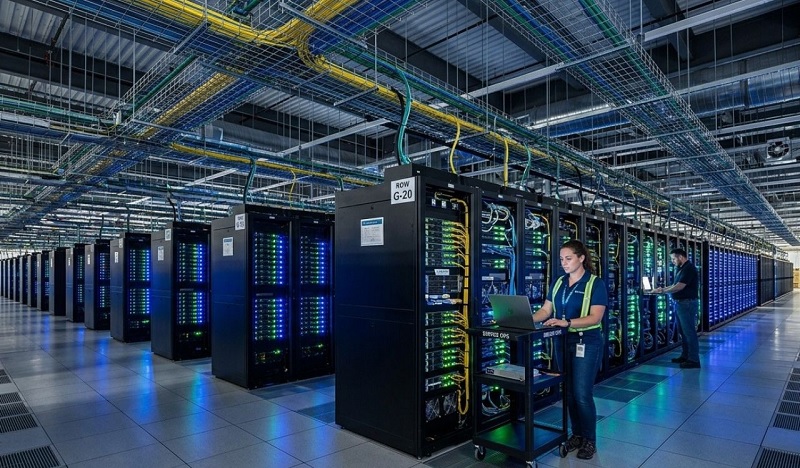
Every time you stream a movie in 4K, execute a high-frequency stock trade, or video chat with a colleague across the globe, you are relying on a massive, physical infrastructure that operates entirely out of sight. We casually refer to this ecosystem as the cloud, an ethereal term that suggests our digital lives float weightlessly in the sky. The reality is far more grounded. The cloud is heavy. It is made of concrete, steel, lithium-ion batteries, and thousands of miles of fiber-optic glass. At the absolute center of this physical internet are data centers. These sprawling, hyper-secure facilities are the engines driving the global economy, tasked with the monumental job of keeping human civilization connected, synchronized, and operational every second of every day.
The Physical Reality of the Cloud
To understand how the global internet remains connected, one must first dismantle the illusion of wireless connectivity. Your smartphone connects wirelessly to a local cell tower or Wi-Fi router, but from that point forward, your data travels through hardwired, physical cables. These cables eventually lead to a data center.
At their core, data centers are specialized buildings designed to house, power, and protect hundreds of thousands of computer servers. These are not the standard desktop computers you might find in a home office. They are densely packed server blades mounted in industrial racks, running non-stop to process astronomical volumes of information. When you upload a document to a cloud storage provider, it is being routed into one of these server racks, written onto a physical storage drive, and indexed for immediate retrieval.
However, a data center is much more than just a massive storage locker. It is an active processing hub. Every search query, artificial intelligence prompt, and financial transaction requires computational heavy lifting. The servers within these facilities are constantly receiving raw data, processing complex algorithms, and instantly transmitting the results back to the end user. Without these concentrated hubs of computational power, the internet as a dynamic, interactive medium would cease to exist.
The Global Nervous System: Interconnection and Routing
A single data center, no matter how powerful, is essentially an island if it cannot communicate with the rest of the world. The true magic of the internet lies in interconnection. Data centers act as the massive intersections where various telecommunications networks meet and exchange global traffic.
This exchange is facilitated by an intricate web of fiber-optic cables that span the globe, including massive submarine cables laid across the ocean floor. When a user in New York accesses a website hosted on a server in London, their request travels as pulses of light through these transatlantic cables in a matter of milliseconds. Data centers located at the coastal landing stations of these submarine cables act as the gateway, catching the international traffic and routing it into the domestic backbone.
Within these facilities, internet service providers, content delivery networks, and cloud providers connect their networks together in a process known as peering. By physically linking their networking equipment with cables inside a neutral, third-party data center, these companies agree to pass traffic back and forth. This localized handover is what creates the interconnected web of the internet. It ensures that data takes the most efficient, direct route possible, minimizing the delay—or latency—between a user clicking a link and a webpage loading on their screen.
The Imperative of Redundancy and Uptime
The global economy cannot afford for the internet to take a day off. Hospitals, financial markets, and emergency response services require absolute, uninterrupted connectivity. To guarantee this level of reliability, data centers are engineered around the concept of extreme redundancy. The philosophy is simple: every critical component must have a backup, and that backup must also have a backup.
Powering the Unstoppable Machine
The primary lifeblood of any server facility is electricity. A sudden power grid failure could theoretically plunge millions of users into digital darkness. To prevent this, modern data centers draw power from multiple independent utility substations. If the municipal grid fails completely, the facility automatically detects the drop in voltage and instantly shifts the electrical load.
Massive arrays of Uninterruptible Power Supply (UPS) systems—essentially rooms filled with high-capacity batteries or kinetic flywheels—bridge the gap for the crucial seconds it takes for the facility’s backup diesel generators to roar to life. These generator farms are kept fueled and primed, capable of powering a massive facility independently for days or even weeks during a prolonged regional blackout. The internet stays online because these buildings are designed to function entirely off the grid if necessary.
Data Replication and Failover
Hardware will inevitably fail. Storage drives crash, routers short out, and fiber lines are accidentally severed by construction crews. Data centers mitigate hardware failure through aggressive data replication. When you save a critical database to the cloud, it is not stored on a single fragile drive. It is instantly copied across multiple servers within the facility.
For even greater resilience, enterprise networks mirror their entire operations across geographically separated data centers. If a severe natural disaster, such as an earthquake or a category five hurricane, physically compromises a facility in one state, automated load balancers instantly reroute all global user traffic to a mirror facility located in a safe region. The end user rarely experiences so much as a hiccup, entirely unaware that a catastrophic physical event just occurred.
Thermal Management: The Battle Against Heat
Operating thousands of high-performance computers in a confined space generates a staggering amount of thermal energy. If left unchecked, this heat would melt delicate silicon processors within minutes, leading to immediate hardware failure and widespread internet outages. Therefore, keeping the internet connected is largely an exercise in advanced thermal engineering.
Data centers employ massive industrial cooling systems to manage this constant thermal output. Many utilize a hot aisle and cold aisle containment strategy. Server racks are arranged in alternating rows, drawing chilled air from the cold aisle to cool their internal components, and exhausting the resulting hot air into an enclosed hot aisle. This superheated air is then pulled up into massive heat exchangers, cooled using chilled water or advanced refrigerants, and recirculated back into the facility.
As processing demands increase—particularly with the exponential growth of artificial intelligence and machine learning models—traditional air cooling is rapidly reaching its physical limits. Next-generation data centers are increasingly turning to liquid cooling technologies. In these cutting-edge setups, chilled fluid is piped directly to the processors, or entire server motherboards are submerged in specialized non-conductive cooling baths. Mastering this thermal dynamic is a prerequisite for keeping data flowing securely and reliably.
Pushing the Boundaries with Edge Computing
Historically, the internet relied on a highly centralized model. Massive hyperscale data centers were built in rural areas where land and electricity were inexpensive. However, this centralization creates a problem for modern applications: physical distance. Data traveling from a user’s device in a major city to a rural data center and back takes time. While this delay is measured in fractions of a second, it is far too slow for next-generation technologies.
Autonomous vehicles processing real-time collision avoidance data, surgeons performing robotic operations remotely, and automated industrial manufacturing lines require instantaneous data processing. To support this, the architecture of the internet is shifting toward edge computing.
Instead of relying solely on remote hyperscale facilities, network operators are deploying hundreds of smaller edge data centers directly into urban environments, cellular tower bases, and commercial hubs. By moving the computational power physically closer to the end user, data does not have to travel across the country to be processed. This localized architecture acts as the new nervous system for the internet, drastically reducing latency and ensuring that bandwidth-heavy applications can operate without bottlenecking the broader network.
The scale and complexity of the digital world are accelerating at an unprecedented pace. As billions more devices come online and complex artificial intelligence integrates into every facet of daily business, the volume of data moving across the globe will reach almost incomprehensible levels. Meeting this demand requires an engineering marvel that operates flawlessly in the background. The next time you open a browser or send an email, it is worth recognizing the immense physical infrastructure making that simple action possible. Massive buildings filled with blinking lights, spinning generators, and miles of glass fiber stand ready, working relentlessly to keep human civilization plugged in, synchronized, and moving forward.