

For decades, professional training relied on a perilous bridge between theory and practice. A trainee absorbed concepts from textbooks, lectures, and static diagrams, only to be thrust into a real-world environment where the cost of a novice mistake could be catastrophic. Whether managing a plunging aircraft, performing invasive surgery, or operating a volatile chemical refinery, the traditional apprenticeship model inherently carried a high degree of risk. You could only learn to handle a crisis by waiting for one to happen.
Advanced simulation technology has completely inverted this model. By creating high-fidelity, interactive, and synthetically generated environments, organizations can now safely expose their workforce to the absolute limits of their professions. Modern simulators do not merely replicate the visual appearance of a workspace; they accurately model the physics, the systemic unpredictability, and the intense psychological pressure of the real world. This transition from passive classroom instruction to immersive experiential learning represents the most significant leap in professional development in the last century.
The Shift Toward Hyper-Realistic Experiential Learning
Early iterations of professional simulation were often little more than glorified video games. They lacked the sensory depth necessary to trick the human brain into treating the virtual experience as reality. Today, the landscape is defined by spatial computing, virtual reality, augmented overlays, and complex mathematical modeling.
The primary advantage of these modern systems is their ability to induce suspension of disbelief. When a professional steps into a modern synthetic environment, their central nervous system reacts as if the stakes are real. Heart rates elevate, adrenaline spikes, and cognitive load maxes out. Because the brain processes these simulated events as actual memories, trainees build genuine experience rather than merely memorizing theoretical protocols. They are allowed to fail catastrophically, analyze the cascading effects of their errors, and reset the scenario with the push of a button.
High-Stakes Industries Pioneering the Technology
While corporate onboarding and soft-skills training are beginning to adopt virtual environments, the technology has been aggressively accelerated by industries where human error translates directly to a loss of life or massive capital destruction.
Aerospace and Aviation
Aviation remains the godfather of simulation training. Commercial and military pilots currently log hundreds of hours in full-flight simulators before ever touching the yoke of a physical aircraft. Modern flight simulators utilize six-axis motion platforms and hyper-accurate aerodynamic software that replicates exactly how a specific airframe handles a microburst, severe icing, or dual engine failure. Pilots are routinely subjected to compound emergencies—a hydraulic failure layered over a severe weather event—that would be impossible and unethical to practice in a live aircraft. This rigorous synthetic training is a primary reason commercial aviation remains statistically the safest mode of global transport.
Healthcare and Surgical Precision
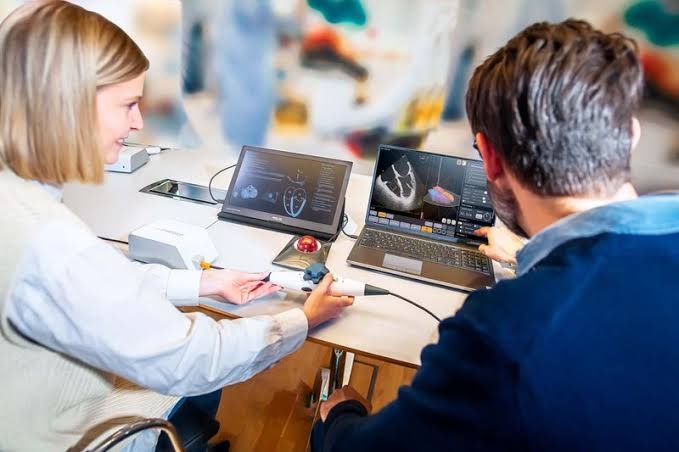
In the medical field, the ethical imperative to “do no harm” historically created a bottleneck for surgical trainees. Learning required practicing on living patients under the watchful eye of an attending physician. Today, surgical simulators utilize advanced spatial rendering and haptic feedback devices to recreate the exact resistance of human tissue. A resident can practice a complex laparoscopic procedure dozens of times, feeling the tactile difference between healthy muscle and a calcified tumor, before ever entering an operating theater. Furthermore, nursing and emergency response teams use immersive simulations to practice triaging mass-casualty events, developing the spatial awareness and rapid communication skills required in chaotic trauma centers.
Energy and Heavy Industry
Operating an offshore drilling rig, a nuclear power plant, or a high-voltage grid involves managing immensely powerful, interconnected systems. In these sectors, simulation takes the form of digital twins—exact virtual replicas of physical facilities, continuously updated with real-time sensor data. Plant operators train on these digital twins to manage pressure spikes, chemical leaks, or critical valve failures. By manipulating the virtual controls, operators learn the exact latency of their systems—understanding, for instance, that adjusting a virtual flow rate will take precisely forty seconds to reflect on their diagnostic gauges, building a crucial intuitive rhythm for their daily operations.
The Cognitive and Physiological Mechanics of Simulation
The effectiveness of advanced simulation is not rooted solely in visual accuracy; it is deeply tied to human biology and cognitive science. Traditional studying utilizes the declarative memory system, but performing complex professional tasks under pressure requires procedural memory, commonly referred to as muscle memory.
Haptic Integration and Tactile Memory
Vision and hearing are only part of the human sensory equation. Advanced training systems now heavily incorporate haptics—technology that creates the sensation of touch by applying forces, vibrations, or motions to the user. When a heavy machinery operator pulls a virtual lever, haptic motors generate the exact mechanical resistance and vibration they would feel in the physical cab. This tactile feedback trains the neuromuscular system, allowing professionals to execute delicate or force-specific maneuvers without having to look at their hands, keeping their visual attention focused entirely on the environment.
Psychological Stress Inoculation
Perhaps the most profound benefit of simulation is its ability to train emotional regulation. In a real-world crisis, a professional’s cognitive bandwidth severely narrows due to the fight-or-flight response. This stress can cause even seasoned veterans to forget basic protocols. Simulators actively subject trainees to sensory overload—blaring alarms, flashing warnings, and chaotic environmental noise. By repeatedly facing these extreme stressors in a controlled setting, professionals develop stress inoculation. They learn to consciously manage their heart rate, suppress panic, and execute their training methodically despite the surrounding chaos.
The Data-Driven Advantage of Virtual Training
In a traditional training environment, evaluating a student’s performance is often subjective, relying on the observational skills of an instructor. Simulation technology replaces subjective observation with granular, objective data analytics.
Modern virtual training environments track thousands of data points per second. Eye-tracking technology records exactly where a trainee looked during a crisis and, more importantly, what critical indicators they missed. The software logs reaction times down to the millisecond, maps the sequence of decisions made, and measures the efficiency of physical movements.
This wealth of data fundamentally changes the debriefing process. Instead of a vague conversation about needing to move faster, an instructor can pull up a 3D playback of the scenario and show the trainee exactly how their delayed visual scan of a pressure gauge led to a critical system failure three minutes later. This creates a highly personalized feedback loop, allowing instructors to pinpoint and correct specific cognitive bottlenecks that would otherwise go unnoticed.
Overcoming Implementation Friction
Despite the overwhelming advantages, transitioning to simulation-based training involves navigating significant structural and financial hurdles. The initial capital expenditure for high-fidelity hardware, motion platforms, and custom software development can be daunting.
However, organizations that successfully integrate this technology view it through the lens of long-term return on investment. The upfront costs are rapidly offset by the savings generated from eliminating the need for physical training consumables, reducing wear and tear on expensive operational equipment, and dramatically lowering insurance premiums. More importantly, the financial mitigation of preventing a single real-world catastrophe often pays for the entire simulation program an hundred times over.
Additionally, organizations must actively combat the phenomenon of simulation sickness—a form of motion sickness caused by a disconnect between visual input and vestibular movement—through careful hardware calibration and incremental exposure. They must also commit to treating their simulators as living ecosystems, constantly updating the software scenarios to reflect the latest industry protocols, newly discovered hazards, and changing equipment interfaces.
The Trajectory of Synthetic Professional Development
We are rapidly approaching an era where the distinction between virtual training and physical operation becomes seamlessly blurred. With the integration of generative artificial intelligence, tomorrow’s simulators will no longer rely on pre-programmed, branching scenarios. Instead, AI will act as a dynamic orchestrator, reading a trainee’s biometric stress levels and performance metrics in real-time to generate completely unique, unpredictable challenges on the fly. If a trainee excels at managing mechanical failures but struggles with communication during a crisis, the AI will autonomously adjust the simulation to test and fortify that specific weakness.
Advanced simulation technology has ceased to be an experimental luxury or an impressive novelty. It has become a foundational requirement for any organization that operates in complex, high-consequence environments. By providing a limitless, consequence-free arena for trial, error, and mastery, simulation technology ensures that when a professional faces their most defining, critical moment in the real world, it is not the first time they have lived it.