

The image of a college student lugging a heavy backpack stuffed with dog-eared spiral notebooks, loose handouts, and an assortment of highlighters is rapidly becoming a relic of the past. Today’s academic environment moves at a blistering pace, bombarding learners with information across lecture halls, seminar rooms, digital textbooks, and online modules. Keeping up with this relentless flow of data requires more than a fast pen and a good memory. Note-taking applications have emerged as essential tools for academic survival and success, transforming how students capture, process, and retain complex information.
Moving far beyond mere word processing, modern digital platforms offer dynamic, interactive ecosystems designed specifically to accommodate the modern learner’s workflow. By shifting from analog pages to digital workspaces, students are discovering profound improvements in how they organize their thoughts, prepare for examinations, and collaborate with their peers.
The Shift from Analog to Digital Learning Environments
The fundamental limitation of physical paper is its rigidity. Once a sentence is written on a page, it is locked in place. If a professor circles back to a topic from three weeks ago, a student using a paper notebook is forced to flip back and forth, drawing messy arrows or starting a disjointed new section. Furthermore, physical notes are susceptible to damage, loss, and the sheer physical weight of carrying multiple subjects’ worth of material across a sprawling campus.
Digital note-taking dismantles these barriers entirely. It introduces an environment where information is fluid, adaptable, and infinitely expandable. Students can restructure their notes on the fly, moving entire paragraphs with a simple drag-and-drop action. As the sheer volume of reading materials and lecture slides increases every semester, having a centralized digital repository is no longer just a convenience; it is a strategic necessity for academic achievement.
Core Advantages of Digital Note-Taking
Transitioning to a digital workflow provides students with several immediate, highly practical benefits that directly impact their daily academic routines.
Total Organization and Instant Searchability
Perhaps the most significant advantage of using a dedicated note-taking application is the elimination of lost information. Digital platforms allow students to create intricate hierarchies of folders, notebooks, and tags, ensuring that every piece of information has a specific, logical home.
More importantly, the integration of powerful search functionalities fundamentally changes how students retrieve information. Instead of spending hours skimming through pages of handwritten text to find a specific definition before a midterm, a student can simply type a keyword into a search bar. Advanced applications now employ Optical Character Recognition (OCR), a technology that scans and indexes text within images, scanned PDFs, and even the student’s own handwritten stylus notes. This means that a snapshot of a whiteboard taken from the back of a lecture hall becomes instantly searchable text within the application.
Seamless Synchronization Across Devices
The modern student is inherently mobile, often studying in short bursts across various locations throughout the day. Cloud-based note-taking applications synchronize data instantly across all connected devices. A student can type comprehensive notes on their laptop during a morning lecture, review those same notes on a tablet at the campus coffee shop in the afternoon, and skim through key bullet points on their smartphone while riding the bus home.
This omnipresence eliminates the friction of studying. Whenever a pocket of free time opens up, the student’s entire academic database is readily available in their pocket. This constant accessibility encourages continuous, low-stress review rather than forced, panicked cramming sessions the night before a test.
Rich Media Integration
Paper limits a student to text and whatever crude diagrams they can manage to sketch by hand. In contrast, digital note-taking applications act as multimedia canvases. Students can record the professor’s audio lecture directly into the app, with the software syncing the audio playback to the exact moment a specific sentence was typed.
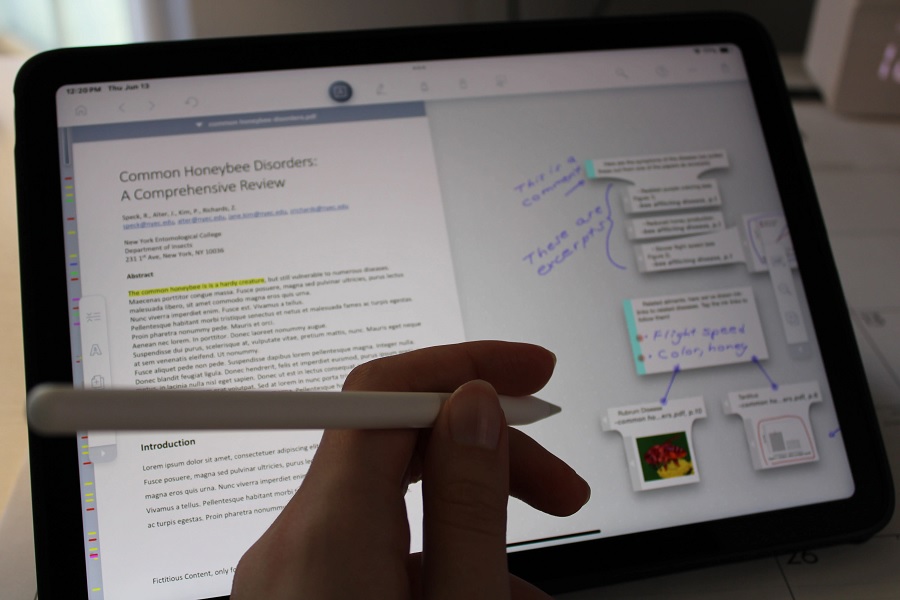
Furthermore, digital notes easily accommodate visual learning. Students can paste screenshots from online tutorials, embed instructional videos, and import massive slide decks provided by the professor. Instead of taking notes on a separate sheet of paper, they can annotate directly over the professor’s slides, typing insights directly next to the relevant charts and graphs.
Transforming Study Habits and Cognitive Retention
Beyond simple organization, the architecture of modern note-taking apps actively facilitates advanced study techniques that are proven to enhance cognitive retention.
Facilitating Active Recall and Spaced Repetition
Cognitive psychology dictates that passive learning—such as simply re-reading highlighted textbook pages—is highly inefficient. The brain learns best through active retrieval, the process of forcing oneself to recall an answer without looking at it.
Many modern note-taking platforms are built with this exact principle in mind. Students can utilize toggle features to hide and reveal text, effectively turning their standard lecture notes into interactive study guides. Others offer seamless plugins that convert highlighted notes directly into digital flashcards. By integrating these practices into their daily workflow, students automatically engage in active recall and spaced repetition, dramatically improving their long-term memory of the material.
Building Interconnected Knowledge Networks
Traditional notebooks force students into a linear, chronological method of learning. Week one comes before week two, and biology notes are strictly separated from psychology notes. However, true higher-level thinking requires understanding how different concepts interact.
Advanced note-taking applications utilize a system of bidirectional linking, allowing students to connect related thoughts across entirely different notebooks. If a student is learning about behavioral conditioning in psychology and animal training in biology, they can link those two notes together. Over time, this creates a deeply personal, interconnected web of knowledge. Building a personal wiki allows students to see the big picture, fostering a deeper, more holistic understanding of their education rather than just memorizing isolated facts.
Streamlining Collaboration and Peer Learning
Higher education places a heavy emphasis on group projects and collaborative research. Historically, this meant emailing Word documents back and forth, resulting in confusing version histories and lost work.
Digital note-taking applications eliminate this hurdle by offering real-time collaboration. Multiple students can occupy the same digital workspace simultaneously, drafting outlines, compiling research links, and editing each other’s work in real time. Even for individual studying, the ability to generate a secure sharing link means that classmates can easily swap study guides or cover for a peer who missed a lecture due to illness. This frictionless sharing promotes a culture of collaborative peer-to-peer learning.
Economic and Environmental Sustainability
While the upfront cost of a laptop or tablet is significant, the long-term economics of digital note-taking can be surprisingly favorable. The hidden costs of the academic year include constantly purchasing new notebooks, binders, index cards, expensive pens, and highlighters. A single digital subscription, or even the utilization of a robust free tier of a note application, replaces all of these physical supplies for the entirety of a four-year degree program.
Equally important is the environmental impact. The modern student body is increasingly conscious of its ecological footprint. The sheer volume of paper waste generated by higher education is staggering. Transitioning to a completely paperless workflow is a tangible, impactful way for students to align their daily habits with their environmental values, dramatically reducing their personal paper consumption and physical waste.
Navigating the Potential Pitfalls
Despite the overwhelming benefits, the transition to digital note-taking is not entirely without friction. The most prominent risk is the close proximity to digital distractions. When studying on a laptop, social media, entertainment, and messaging platforms are only one click away. Maintaining focus requires discipline.
Additionally, some students fall victim to “shiny object syndrome.” They spend so much time customizing their app’s interface, organizing their folders by color, and downloading new plugins that they neglect the actual studying. The software becomes a procrastination tool in disguise.
To overcome these hurdles, students must be intentional about their digital habits. Utilizing distraction-free writing modes, employing website blockers during study hours, and choosing an application that complements their natural thinking style rather than overcomplicating it are crucial steps for success. The goal is to use the software as a frictionless extension of the mind, not as a complex puzzle that needs to be solved.
The Future of Academic Management
The adoption of digital note-taking applications represents a fundamental shift in the educational experience. These platforms are not merely digital replacements for spiral notebooks; they are highly customized, intelligent systems designed for lifelong learning and knowledge management. By embracing these tools, students do much more than keep their backpacks light and their desks clean. They empower themselves to organize vast amounts of information, build powerful study habits, and engage with their coursework on a much deeper, more analytical level. Ultimately, students who master their digital workflows are equipping themselves with the essential information management skills required not just for the classroom, but for the modern professional world that follows.